Recently I came across a branding photo of a woman who was obviously an author. She was sitting on the living room floor with a sofa and a carefully draped blanket behind her, while an artfully arranged pile of books and a typewriter filled the foreground. She was dressed in jeans, a blazer and heeled boots. Her expression was neutral, looking at the camera with a slight smile. Except for her jeans, everything in the photo was beige.
Don’t get me wrong, it was a beautiful, very well-executed photograph. But what was it about? Could I tell what kind of author she was? What kind of person she was? The photograph was visually pleasing, but sterile, stripped of emotion and individuality.
I was curious, so I looked up her books. From that branding photo, I never would have expected them to be ornate fantasy novels.
What Schemas Have to Do With Branding Photography
This reminded me of schemas.
Schemas are mental blueprints we carry around about the world. We know, for example, that a chair has a seat, a back and some sort of legs. When we see a chair, even a very unusual chair, we can quickly recognise it as one. Schemas allow our brains to run efficiently without needing to process everything from scratch.
Now think about artists and children drawing a table in front of them.
A child will likely draw “a” table, relying on their internal idea of what a table looks like. If they are older, they may notice that this particular table is dark brown and has a pedestal instead of the usual four legs, and include those details in the drawing.
An artist, on the other hand, will squint their eyes, look carefully and draw what they truly see: the shapes, the shadows, the negative space around the table. Artists spend years training themselves out of relying on schemas and learning to really see what is there.
Photographing a Schema vs Photographing a Person
You may be wondering what all this has to do with your branding photos.
Everything.
Say you are a coach, a VA, a web designer or an event planner. Do your photos reflect what “a coach” looks like, or who you, Sarah the Coach, are and how your approach differs from every other coach in the room?
I use coaching as an example because every networking event seems to contain at least a few coaches, and because coaching is difficult to represent visually. When you think of a coach’s website, what comes to mind? What would you expect to see?
I bet you just imagined a woman in a neutral-toned living room laughing at nothing while holding a mug. She is safe, friendly and approachable. Or perhaps she is sitting in front of a laptop mid-client call: warm, efficient and somehow completely unremarkable.
These images are not bad. They simply rely on schemas. They tell us what category this person belongs to, but not who they are.


Interestingly, both of these portraits of myself were taken on the same day by two different photographers. Same person, same clothes, same business. But they create very different impressions of who that person is.
How I Approach Branding Photography Differently
The way I work is different. I don’t photograph schemas. I photograph people. I don’t stage you into a role. I try to see you clearly.
Take a recent branding shoot with Jo, who is, as you can probably guess, a coach. When I was planning her branding session, I looked at what her business was really about. And it was not shiny promises or dramatic transformations. Her work is about helping clients move from a state of flatness to a state of feeling a spark inside themselves again. She has a clear path that takes people from point F, flatness, to point S, spark.
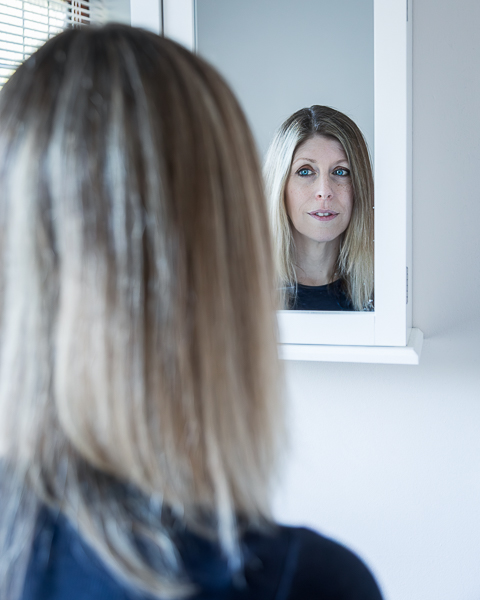
So while planning the session, I was not thinking primarily about poses or props. I was thinking about emotional states. What does flatness look like? What does spark look like? What shifts between those two points?
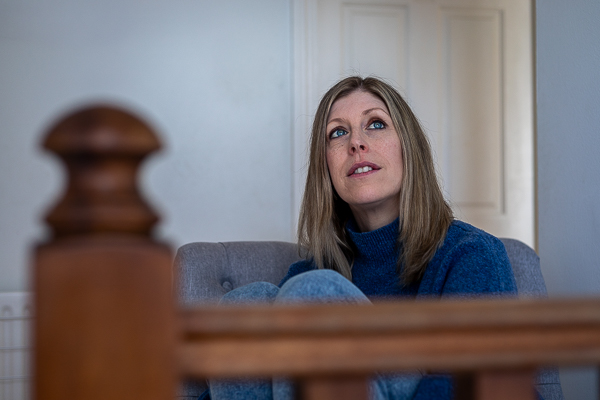
The photos were taken in her house and in a green space where she genuinely likes to walk. When you see her at a desk, it is her desk. When you see her on a sofa with a notebook, it is her sofa. The clothes she is wearing are her real clothes. Her expressions are not performative.
But most importantly, the photographs reflect the emotional states she works with, the way she guides people through them and the experience of working with her specifically. Those things are uniquely hers.
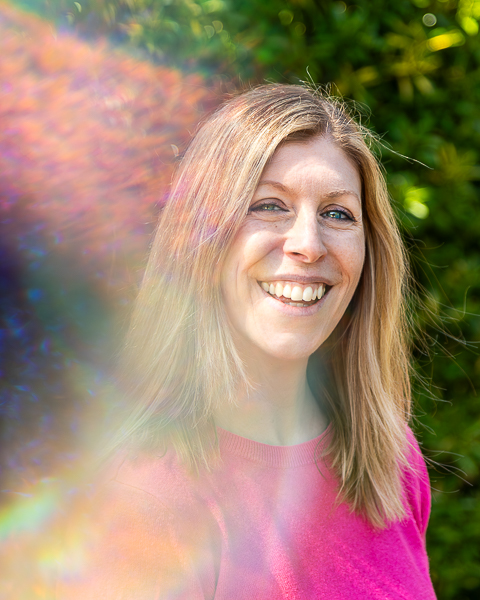
You would never invent these images by simply asking yourself what branding photos of “a coach” should look like. And that is the point.
Why Accurate Branding Photos Matter
Schemas are supposed to make us recognisable. But often they do the opposite: they smooth away the very things people connect to.
The businesses I am most drawn to are usually not the most polished or neutral. They are the ones where I can sense a real person behind the work. Someone specific. Someone with their own rhythms, contradictions, sensitivities, way of thinking and seeing the world. That is what I want your branding photos to do too.
Not to prove that you can perform the role of “a business owner” convincingly enough, but to help people understand who you are and what it feels like to work with you.
Because your clients are not looking for “a coach”. They are looking for their coach. And those are not the same thing.
That is the work I am interested in making.